Building a solid foundation of core sciences and communication skills for future engineering leaders.
Established
First Year Support
Science Laboratories
Syllabus Aligned
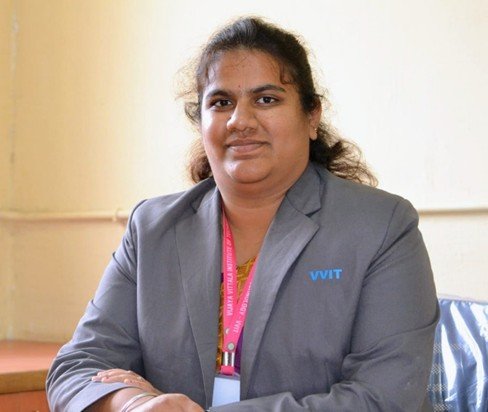
Professor & Head
Welcome to the Department of Basic Science at VVIT. The first year of engineering lays the foundation for every student's professional journey, and our department takes this responsibility with great commitment. We focus on strengthening core concepts in physics, chemistry, mathematics, and communication skills that are essential for all branches of engineering. Our experienced faculty members provide personalized attention and mentoring to help every student succeed. We foster a culture of curiosity, analytical thinking, and continuous learning from day one. I welcome all students to an enriching academic experience at VVIT.— Dr.HoD, Professor & Head
To build a strong foundation for future engineering graduates through quality education and research in basic sciences.
To impart quality education in physics, chemistry, mathematics, and humanities to build a solid engineering foundation.
To foster critical thinking, problem-solving skills, and lifelong learning attitudes.
To provide state-of-the-art laboratory facilities for hands-on experimental learning.
Apply knowledge of mathematics, natural science, computing, engineering fundamentals and an engineering specialization to develop solutions to complex engineering problems.
Identify, formulate, review research literature and analyze complex engineering problems reaching substantiated conclusions with consideration for sustainable development.
Design creative solutions for complex engineering problems and design/develop systems to meet identified needs with consideration for public health, safety, and environment.
Conduct investigations of complex engineering problems using research-based knowledge including design of experiments, modelling, analysis & interpretation of data.
Create, select and apply appropriate techniques, resources and modern engineering & IT tools, recognizing their limitations to solve complex engineering problems.
Analyze and evaluate societal and environmental aspects while solving complex engineering problems for its impact on sustainability.
Apply ethical principles and commit to professional ethics, human values, diversity and inclusion; adhere to national & international laws.
Function effectively as an individual, and as a member or leader in diverse/multi-disciplinary teams.
Communicate effectively within the engineering community and society at large, including effective reports, design documentation, and presentations.
Apply knowledge of engineering management principles and economic decision-making to manage projects in multidisciplinary environments.
Recognize the need for independent and life-long learning, adaptability to new technologies, and critical thinking in the context of technological change.
A systematic, theory-based understanding of the natural sciences applicable to the discipline and awareness of relevant social sciences.
Conceptually-based mathematics, numerical analysis, data analysis, statistics and formal aspects of computer and information science to support detailed analysis and modelling.
A systematic, theory-based formulation of engineering fundamentals required in the engineering discipline.
Engineering specialist knowledge that provides theoretical frameworks and bodies of knowledge for the accepted practice areas in the engineering discipline.
Knowledge supporting engineering design and operations in a practice area, including efficient resource use, environmental impacts, and net zero carbon.
Knowledge of engineering practice (technology) in the practice areas in the engineering discipline.
Knowledge of the role of engineering in society and identified issues, such as professional responsibility to public safety and sustainable development.
Engagement with current research literature of the discipline, awareness of critical thinking and creative approaches to evaluate emerging issues.
Ethics, inclusive behavior and conduct. Knowledge of professional ethics, responsibilities, and norms of engineering practice with diversity awareness.
Graduates will possess a strong foundation in basic sciences, mathematics, and communicative English required to analyze and solve complex engineering problems.
Graduates will demonstrate robust analytical, critical-thinking, and problem-solving skills to adapt to multidisciplinary technological advancements.
Graduates will cultivate professional communication, teamwork skills, and ethical behavior to work effectively in diverse corporate and academic settings.
Ability to apply the concepts of engineering physics and engineering chemistry to analyze material properties, design environmental systems, and develop technological prototypes.
Ability to utilize advanced calculus, differential equations, and linear algebra techniques to formulate and solve mathematical models of physical and engineering processes.
Get in touch with us to know more about curriculum, faculty, and admissions.
Established
Personalized Mentorship
Foundation Labs