Loading...
Vijaya Vittala IT
📞 +91 8050472867 (Admissions Only)

Department of Artificial Intelligence & Machine Learning

Shaping the Future through Intelligent Systems and Deep Learning

Apply Now
VVIT Campus

Artificial Intelligence & Machine Learning

The Department of Artificial Intelligence & Machine Learning in VVIT was established in 2022 & it currently offers an undergraduate course in Artificial Intelligence & Machine Learning with an intake of 60 students.

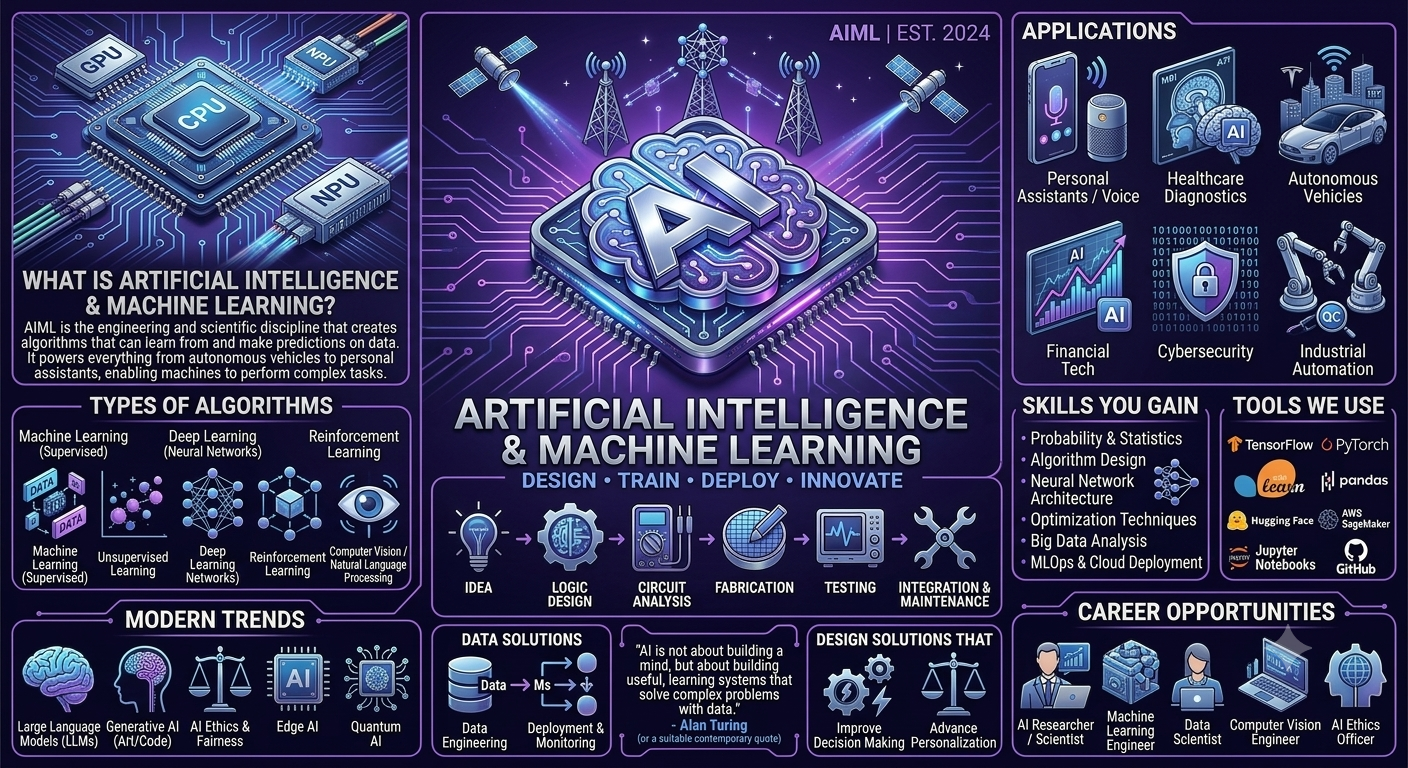
Bachelor of Technology in Artificial Intelligence & Machine Learning equips students with the skills and knowledge required to analyse, design and control intelligent systems. The main objective of offering this program is developing professionals who are skilled in the area of AI & ML. This program enables students to gain in-depth understanding of fundamental subjects in Computer Science and deals with technologies like image processing, machine learning, natural language processing, neural networks, deep learning, reinforcement learning and big data analytics. This course is designed for both academic and skill based education to create a bright career for the students.

The faculty members of the department have extensive industry and teaching experience, hence enabling them to impart an amalgamated teaching technique that will prepare the students for the tough industry benchmarks. The department has a collection of reference books and software packages. The impact of our ideas and our students extend globally in meaningful and effective ways.

We have complete fledged labs according to the academic plans of VTU. The laboratories have modern computing facilities with the latest branded desktops, and three 50Mbps Internet lines which aid the students in research and referencing.
Department Highlights

2022

Established

UG

Program in AI & ML

60

Approved Student Intake

Research

Focused Curriculum

High-End

Computing Labs

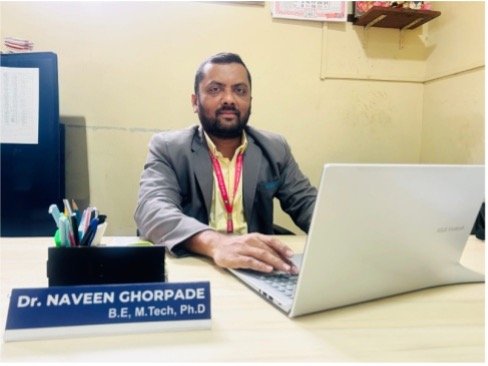
Dr. Naveen Ghorpade

Dr. Naveen Ghorpade

Professor & HOD

Welcome to the Department of Artificial Intelligence & Machine Learning at VVIT. Our department is committed to shaping future-ready professionals in one of the most transformative fields of technology. We offer a curriculum that blends strong theoretical foundations with practical, hands-on experience in AI, deep learning, and data-driven innovation. Our faculty and modern infrastructure create an environment that nurtures creativity, critical thinking, and research excellence. We prepare our students to lead the next wave of intelligent solutions that will shape industries and society. On behalf of the entire faculty, I wish all students a disciplined and bright future.
— Dr. Naveen Ghorpade, Professor & HOD
VVIT

Why Choose AI & ML @ VVIT

  • Strong foundation in Computer Science, Artificial Intelligence & Machine Learning
  • Industry-focused curriculum with hands-on practice
  • Training in deep learning, neural networks, image processing, and natural language processing
  • State-of-the-art computing facilities and VTU-compliant laboratories
  • Excellent career guidance and placement opportunities in top tech companies
  • Research-driven environment under experienced and dedicated faculty members

Career Opportunities

  • AI Engineer
  • Machine Learning Engineer
  • Data Scientist
  • Research Scientist
  • AI Data Analyst
  • Big Data Engineer
  • Robotics Scientist
  • Full Stack Developer
  • Healthcare
  • Transport & Automotive
  • Security & Defense
  • Gaming & Entertainment
  • Finance & Banking
  • Customer Support & Analytics
  • Search Engines & Recommendation Systems
  • Smart Home & IoT Devices

Vision of the Department

To emerge as a center of excellence in Artificial Intelligence and Machine Learning through quality education, research, and cognitive innovation, preparing students to solve complex real-world challenges ethically.

Mission of the Department

M1

Provide comprehensive learning in Artificial Intelligence with ethical values

M2

Enhance industry readiness through practical exposure to machine learning frameworks

M3

Promote research, innovation, and entrepreneurship in cognitive systems

M4

Develop intelligent solutions to solve real-world industrial and societal problems

Labs & Infrastructure

Object Oriented Programming with JAVA Laboratory
Data Structures Laboratory
Analog and Digital Electronics / Digital Design
Design and Analysis of Algorithm Laboratory
Microcontroller and Embedded Systems Laboratory
Python Programming Laboratory
Computer Network Laboratory
DBMS Laboratory with mini project
Machine Learning Laboratory
Operating Systems Laboratory

Program Details

POs
WK
PEOs
PSOs
PO1: Engineering Knowledge

Apply knowledge of mathematics, natural science, computing, engineering fundamentals and an engineering specialization to develop solutions to complex engineering problems.

PO2: Problem Analysis

Identify, formulate, review research literature and analyze complex engineering problems reaching substantiated conclusions with consideration for sustainable development.

PO3: Design/Development of Solutions

Design creative solutions for complex engineering problems and design/develop systems to meet identified needs with consideration for public health, safety, and environment.

PO4: Investigations of Complex Problems

Conduct investigations of complex engineering problems using research-based knowledge including design of experiments, modelling, analysis & interpretation of data.

PO5: Engineering Tool Usage

Create, select and apply appropriate techniques, resources and modern engineering & IT tools, recognizing their limitations to solve complex engineering problems.

PO6: The Engineer and The World

Analyze and evaluate societal and environmental aspects while solving complex engineering problems for its impact on sustainability.

PO7: Ethics

Apply ethical principles and commit to professional ethics, human values, diversity and inclusion; adhere to national & international laws.

PO8: Individual and Collaborative Teamwork

Function effectively as an individual, and as a member or leader in diverse/multi-disciplinary teams.

PO9: Communication

Communicate effectively within the engineering community and society at large, including effective reports, design documentation, and presentations.

PO10: Project Management and Finance

Apply knowledge of engineering management principles and economic decision-making to manage projects in multidisciplinary environments.

PO11: Life-Long Learning

Recognize the need for independent and life-long learning, adaptability to new technologies, and critical thinking in the context of technological change.

WK1: Natural Sciences Knowledge

A systematic, theory-based understanding of the natural sciences applicable to the discipline and awareness of relevant social sciences.

WK2: Mathematical & Data Analysis

Conceptually-based mathematics, numerical analysis, data analysis, statistics and formal aspects of computer and information science to support detailed analysis and modelling.

WK3: Engineering Fundamentals

A systematic, theory-based formulation of engineering fundamentals required in the engineering discipline.

WK4: Specialist Practice Knowledge

Engineering specialist knowledge that provides theoretical frameworks and bodies of knowledge for the accepted practice areas in the engineering discipline.

WK5: Engineering Design & Net Zero

Knowledge supporting engineering design and operations in a practice area, including efficient resource use, environmental impacts, and net zero carbon.

WK6: Engineering Practice & Technology

Knowledge of engineering practice (technology) in the practice areas in the engineering discipline.

WK7: Engineering in Society

Knowledge of the role of engineering in society and identified issues, such as professional responsibility to public safety and sustainable development.

WK8: Research Literature Engagement

Engagement with current research literature of the discipline, awareness of critical thinking and creative approaches to evaluate emerging issues.

WK9: Ethics & Diversity Awareness

Ethics, inclusive behavior and conduct. Knowledge of professional ethics, responsibilities, and norms of engineering practice with diversity awareness.

PEO1: Technical Excellence

Graduates will excel in careers related to Artificial Intelligence and Machine Learning, demonstrating strong technical skills, innovation, and adaptability to evolving technologies.

PEO2: Continuous Learning

Graduates will engage in continuous learning and professional development to stay at the forefront of advancements in AI and ML, contributing to organizational growth.

PEO3: Real-World Solutions

Graduates will apply knowledge in AI and ML to develop solutions addressing real-world problems, ensuring ethical practices and societal well-being.

PEO4: Leadership & Collaboration

Graduates will exhibit leadership qualities and work effectively in multidisciplinary teams, contributing to the successful execution of innovative projects.

PSO1: Data-Driven Applications

Graduates will design, develop, and implement data-driven applications using data engineering, statistical modeling, machine learning, and visualization techniques to support decision-making.

PSO2: Advanced Insights & Analytics

Graduates will analyze and interpret complex datasets across various domains using statistical, ML, and data mining techniques to generate actionable insights.

PSO3: Applied Research & AI Ethics

Graduates will contribute to innovation and applied research in data science, promoting responsible AI, data ethics, and impactful societal applications.

Syllabus, Notes, Previous Question Papers & Academic Calendar

Academic Calendar of Events (Odd Semester 2026-27)

📄 Download Calendar (PDF)
August 03, 2026 Commencement of classes for B.E. (3rd, 5th, 7th Semesters)
Academic
September 14 - 16, 2026 First Internal Assessment (IA-1) for all higher semesters
Exam
October 09 - 10, 2026 PRAGNA - National Level Technical & Cultural Fest
Event
October 26 - 28, 2026 Second Internal Assessment (IA-2) & Lab Evaluations
Exam
November 07, 2026 Parent-Teacher Meeting (PTM) & Display of IA-2 Marks & Attendance
Academic
November 23 - 25, 2026 Third Internal Assessment (IA-3) & Remedial Classes
Exam
December 05, 2026 Last Working Day for all semesters & Submission of IA Marks
Academic
December 08 - 15, 2026 VTU Semester End Practical Examinations
Exam
December 18, 2026 - Jan 15, 2027 VTU Semester End Theory Examinations
Exam

Subject-wise Syllabus Explorer

1st Sem
2nd Sem
3rd Sem
4th Sem
5th Sem
6th Sem
7th Sem
8th Sem

Subject-wise Notes Explorer

1st Sem
2nd Sem
3rd Sem
4th Sem
5th Sem
6th Sem
7th Sem
8th Sem

Subject-wise QP Explorer

1st Sem
2nd Sem
3rd Sem
4th Sem
5th Sem
6th Sem
7th Sem
8th Sem

Department Faculty and Staff Details

Department Faculty
Professor of Practice (PoP)
Dr. Naveen Ghorpade
Dr. Naveen Ghorpade
Professor & HOD
Ph.D
Prof. Manasa M
Prof. Manasa M
Assistant Professor
M.Tech (PhD)
Prof. Sindhu K
Prof. Sindhu K
Assistant Professor
M.Tech (PhD)
Prof. Amala G
Prof. Amala G
Assistant Professor
M.Tech
Mrs. Shantarani S B
Mrs. Shantarani S B
Assistant Professor
M.Tech
Mrs. Sangeetha
Ms. Sangeetha C
Assistant Professor
M.Tech.
Mrs. Sangeetha
Mrs. Priyanka Kanavalli
Assistant Professor
M.Tech.
Ms. aashai
Ms. Aashabi
Lab Instructor
B.E
Dr. S M Vijaya Kumar
Associate Professor & HOD
M.Tech, PhD
Veena N
Veena N
Assistant Professor
M.Tech
Roopa G T
Roopa G T
Assistant Professor
M.Tech

Research & Innovation

  • Data Scientist
  • Machine Learning Engineer
  • Data Analyst
  • Big Data Engineer
  • Deep Learning Engineer
  • Workshops & Seminars
  • Research Projects
  • Industry-oriented Mini & Major Projects

Events & Activities

🎯 AICTE Activity Point Programs
🌿 Swachh Bharat Abhiyan
♻️ Garbage Disposal System Activity
🌾 GKVK Krishi Mela Visit
🙏 Department Pooja Ceremony
📚 PRAGNA Event
⚽ Sports & Wellness Activities

Faculty Achievements

  • 20+ research publications by HOD
  • IEEE & SCOPUS indexed publications
  • Professional memberships & editorial roles
  • FDPs, invited talks & research guidance

Student Achievements

  • National Roller Skating Championship participation
  • Cultural fest achievements

Student Development

  • Internships & industry exposure
  • Real-world datasets and projects
  • Technical events and innovation activities
  • Career guidance and placement support

Training & Technical Skills

PythonRJavaScalaTensorFlowPyTorchScikit-learnData VisualizationBig DataCloud Computing

Gallery

Ready to Build Your Career in Data Science?

Take the first step towards a successful career in engineering

100%

Scholarship Available

Easy

Admission Process